Friday, October 8, 2010

Wild Roosters


I have a group of all boy Kindergarten and 1st graders who are teaching me a thing or two about my approach to teaching art. I am lucky enough to have an active group of young boys join me in following art lessons after 6 hours of sitting still and listening at school. My son was all energy at this age (and his Pre-K teacher told me his scissor skills were less than spectacular and I should work with him on that) so I really get where they're coming from. I have yet to do an art lesson with templates or tracers in the 4 weeks of this art session. This may change - don't judge me, ha :) I am really trying to let the art come from them, no matter where they are in their fine motor control development. The fact that these are paid for art classes may cause me to struggle with the process vs. product issue a bit more. But I think as a parent, you really cherish a piece of art that comes from the child with as little interference as possible. So here are a few roosters from my Picasso rooster lesson. They are rough, wild and I think very expressive.

By the way, my now 15 year son does just fine with a pair of scissors :D

Wednesday, October 6, 2010

Rex Ray Inspired Collages


Some of my students are creating collages loosely based on the work of artist, Rex Ray. The San Francisco based artist and former graphic designer creates gorgeous collages with layers of color, patterns and shapes, from the minimal to the ornate. He started making collages by cutting up magazines into interesting compositions after his day job as a graphic designer left him creatively stifled. He made hundereds of simple works, without judging them or over-thinking. (He clearly shut off his left brain.) He now sells his pieces in galleries as well as through Designer, Jonathon Adler.


I wanted to give the kids an inspirational spring board for this project. So I asked them to create an underwater fantasy garden or a garden found somewhere on another planet. (I even played The Beatles' Octopus's Garden to help transport their minds.) They first created their background atmosphere by painting their board with several colors without pre-mixing to give some added dimension to their piece. They could then use magazines, leftover textured paper, and scrapbook paper to create shapes for their fantasy worlds. I've encouraged them to repeat some of their papers and shapes to keep the viewer's eye moving and use the design principle of repetition.

Sunday, October 3, 2010

Eric Carle Inspired Cityscapes


While one of my classes is in phase 1 of their sunset cityscapes, I thought I'd try an Eric Carle inspired cityscape collage with my K thru 3rd grade class. With such a range of ages, I try to find projects where every child can feel successful. In Eric Carle's, Animals Animals book there is a wonderful (ok they are ALL wonderful) nighttime city collage about an electric eel that could light up all of New York's streets. The children were allowed to create a nighttime or daytime sky with a variety of tempera paints. They then got to work cutting their sky scrapers (some opted to paint their buildings). They could use leftover textured paper, paints or oil pastels to create their windows. Lastly they could add finishing touches to their sky.


Friday, September 24, 2010

Olivia with a Jackson Pollock


I had to join in on the fun as well.


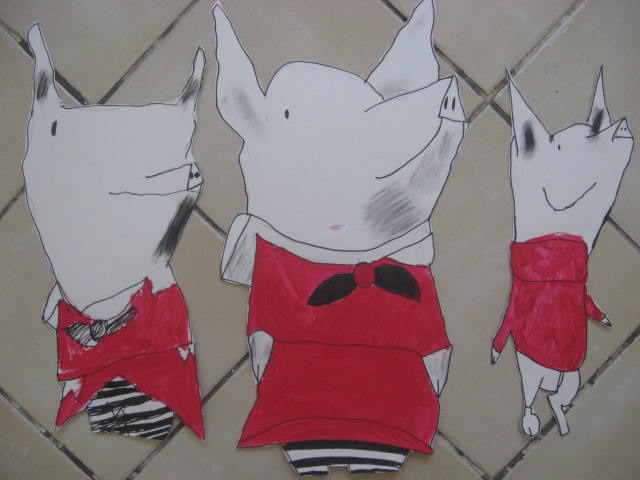
Sometimes I don't have to look any farther for inspiration for an art lesson than my daughter's bookshelf. So my Thursday afternoon group of Kindergarten thru 3rd graders took a look at the adorable (and familiar to all of them) Olivia by Ian Falconer. In the story Olivia's mother takes her to an art museum on rainy days. She always heads straight for her favorite Degas ballet piece. From there she stands in front of Jackson Pollock's Autumn Rhythm #30. Her reaction, "I could do that in about five minutes."
So I thought it would be fun do a line drawing of Olivia the pig with smudged charcoal shadows and her trademark red outfit and combine it with a splattered piece. The boys swapped the sailor dress for a red turtleneck, turning their pig into more of an Oliver. (my apologies to Mr. Falconer :) The children took turns with some Abstract Expressionism using watered down black and white tempera on a sheet of construction paper. The pigs (all so wonderfully different and full of humor and character) were cut out and placed in front of their splattered art piece and mounted on black posterboard. Nice job kids!

Wednesday, September 22, 2010

Sunset Cityscapes


There are certain art projects I am drawn to - Cubism, Impressionism, birds and cityscapes come to mind. Everytime I spot a cityscape project on another blog, I ooh and aah. My "favorites" list are filled with cityscape art project ideas. Maybe I'm just nostalgic for my days living in the fabulous Midtown Atlanta or in the bustling Miracle Mile section of Los Angeles.(I lived literally a stone's throw from the Los Angeles County Museum of Art and would take my then 3 year old) son to the children's space there on a weekly basis. People laugh when I tell them that the transition from L.A. to a quiet beach town was a difficult one. It was hard going to sleep at night without the hum of traffic and helicopters. :)


Back to art projects! I found the idea for this one on Artsonia. Credit goes to Muraski Elementary School in Stronsville, Ohio. There are some gorgeous pieces posted there. My example pales by comparison. And I have to really give credit to the teacher for the variety of unique sunset cityscapes. This is not a cookie cutter collection. So being that the sunsets in L.A. are particularly beautiful this time of year, I am going to do this project with my 3rd-5th graders to satisfy my selfish craving to enjoy them.


After drawing a faint horizon line, the children will use watercolor to create their sunsets. I plan to offer a few examples to show the magnificent colors and variety of sunsets, stressing to blend the colors with a brushstroke of water when needed. The water beneath the city can be painted in the same way. Yellows or pinks (or other colors for that matter) can be added in narrow verticle lines to echo the sky scraper lights they will add later. After the watercolor has dried, the children will paint a variety of black buildings using acrylic, varying their heights and style to add interest. Using the back of a small paintbrush dipped in a variety of colors, they can create the lighted windows. They can keep their palette limited with this part or use the rainbow. The last touch is to add some horizontal lines to create water reflections.

Monday, September 13, 2010

Cardboard Masks Inspired by Kimmy Cantrell and Eric Straw


The above masks were created by 3rd-5th graders.


My 3rd-5th graders looked at the masks of artists Kimmy Cantrell and Eric "Straw" (Strawczynski). They come from completely different walks of life, yet have distinct parallels. Cantrell is an African American artist from Atlanta Georgia. Once a purchasing manager for Target, he decided on the heels of job change and divorce to reconnect with his love of clay. Vases evolved into bowls and bowls into his current niche, faces. Now as a full time artist, Cantrell creates clay masks with both tribal and Cubist influences. They have wonderful bold graphic shapes, interesting textures and eye popping candied glazes. I knew instantly my students would enjoy his primitive and edgy take on the human face. Minus a kiln, I decided to do a recycled cardboard approach to these masks. Literally a day before my class, I came across the fabulous work of Eric Straw from St. Martha Catholic School Artists (this is why I so love the give and take of art teacher blogging). What amazing luck to find an artist whose masks have both tribal and sometimes Cubist roots, bold features.....and that uses cardboard and only cardboard! Straw, (as his friends call him) who worked as a professor and researcher in social sciences, turned to antique toys to escape this left brained world. He not only became an expert in that genre but began creating his own marionettes, busts and masks. His work contains bold imagery as Cantrell's, combined with a lot of humor. This humor would go far with my spirited and lively group of 8 to 10 year olds.


Today my students mapped out their face shape on cardboard and got to work on creating their unique facial features. Some did this directly on their cardboard. Others used remnants of cereal and cracker boxes and cut out their facial features. Paint and oil pastels were offered to add color to their masks. I took Kimmel's use of large nails on some of his masks a bit further. I offered keys, nuts, bolts, pennies, soda can tops, hooks and even fettucini noodles (the hair on the 2nd mask) and quite a few more items to echo the humor of Straw's pieces. Many of these items slip easily between the corrugated cardboard. My kids are off to a great start. I will have some wonderful unique masks to post next week.

Sunday, September 5, 2010

Multi-Media Cubist Roosters


Inspiration - Picasso's Le Coq


Phase 1 - decoupage


Painting over direct line draw of rooster


Paint piece using a limited palette


My students this session will be creating art pieces with some added twists. One of my first projects is a multi-media piece based on Picasso's, "Le Coq." To add some extra visual interest the children will decoupage some ripped material with watered down glue. I'm offering phone book pages, newspaper, scrapbook paper, recycled textured paper, tissue paper, and magazines. I will encourage the children to repeat their choices to give their artwork some visual movement. The following week they will go over their textured board with a direct line drawing lesson of Picasso's abstracted rooster. I think the bold geometric shapes will work very well for the children. They will paint over their pencil lines with black acrylic and a stiff thin brush. They can choose to paint over some of the lines of their ripped paper or keep their composition more simple. My background is a bit involved. They can opt to paint over their materials to create a more solid background (like Picasso). By offering a limited palette, I explain that their eyes will dance around their repeated colors and patterns. I will also point out how Picasso's repetition of lines, shapes and colors cause the viewers eye to move around his painting. (example: Look how many times Picasso repeated the triangle kids?)